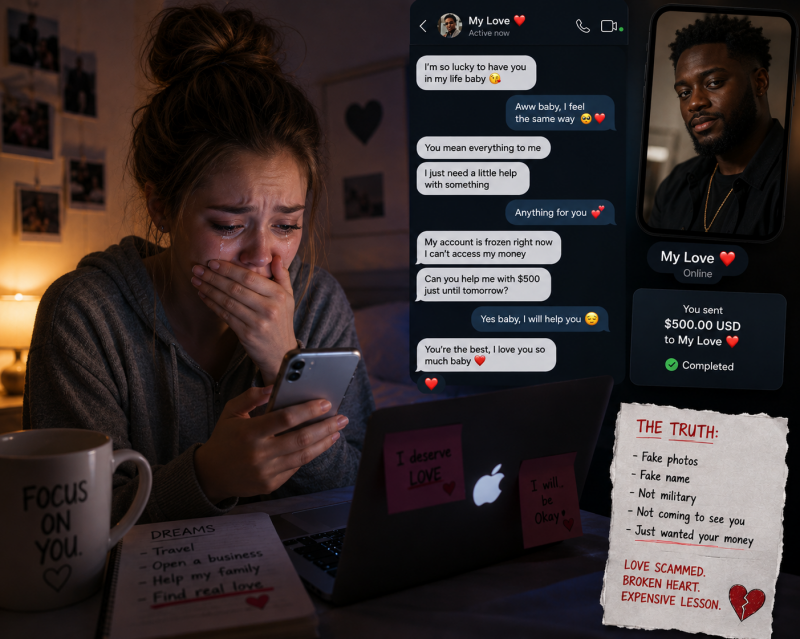
Love, Lies, and the Digital Trap
There’s a particular kind of heartbreak that doesn’t come from love alone—but from deception dressed as love. It’s the kind that leaves you questioning not just someone else’s intentions, but your own judgment. And in today’s hyper-connected world, it’s happening more often than most people realize.
Online romance scams—often tied to organized groups like the so-called “Yahoo Boys” operating out of Nigeria—have evolved into highly sophisticated emotional operations. These aren’t just random messages from poorly written scripts anymore. They are calculated, patient, and disturbingly convincing.
How It Starts
It usually begins innocently enough. A friend request. A message. A comment on a post. The profile looks real—sometimes even impressive. Maybe they claim to be a successful entrepreneur, a deployed military officer, or a widowed parent trying to rebuild their life. Their photos are polished, their words are warm, and their attention feels… intentional.
And that’s the hook.
They don’t rush. In fact, they take their time building trust. They learn your routines, your vulnerabilities, your dreams. They mirror your emotions. They tell you exactly what you didn’t even realize you needed to hear.
The Illusion of Connection
What makes these scams so powerful isn’t just the lie—it’s the emotional investment. You’re not just talking to someone. You’re building something. Or at least, it feels that way.
They’ll say “good morning” and “goodnight” every day. They’ll talk about a future together. They’ll call you “my love,” “my queen,” “my everything.” And slowly, without realizing it, you begin to care. Deeply.
That’s when the story shifts.
The Ask
It’s rarely sudden. There’s always a reason—an emergency, a delay, a problem that only you can help solve.
-
A business deal gone wrong
-
A frozen bank account
-
A medical emergency
-
A plane ticket to finally come see you
The details vary, but the urgency is always the same. And because you care, because you believe in them, you want to help.
That’s when money enters the picture.
The Reality Behind It
Groups like the “Yahoo Boys” aren’t just individuals sitting behind screens—they’re often part of organized networks that specialize in emotional manipulation. They study human behavior. They share scripts. They even celebrate successful scams.
To them, it’s a game. To the victim, it’s devastating.
And the truth is, it can happen to anyone.
It doesn’t matter how smart you are, how experienced you are, or how cautious you think you’ve been. When emotions are involved, logic can quietly take a back seat.
The Aftermath
When the truth finally surfaces—and it always does—it hits hard.
There’s anger. Embarrassment. Shame. But more than anything, there’s grief. Because even if the person wasn’t real, the feelings were. The connection felt real. And losing that can feel just like any other heartbreak.
But here’s what needs to be said clearly:
You were not foolish. You were human.
Protecting Yourself (Without Losing Hope)
The goal isn’t to become cold or closed off. It’s to stay aware.
-
Be cautious of anyone who moves too fast emotionally
-
Avoid sending money to someone you’ve never met in person
-
Reverse-image search profile photos
-
Be skeptical of stories that always seem to need financial help
-
Trust your instincts—if something feels off, it probably is
And most importantly—talk about it.
Scammers thrive in silence.
The more we share these experiences, the harder it becomes for them to succeed.
Final Thoughts
Love should never come with secrecy, pressure, or financial obligation—especially from someone behind a screen.
The digital world has made connection easier than ever but it has also made deception easier to hide.
So stay open—but stay aware.
Because real love doesn’t ask you to prove it with your bank account.
It shows up. It’s consistent. And it’s real.
Love,
Lisa
Add comment
Comments